Emotions Worksheets
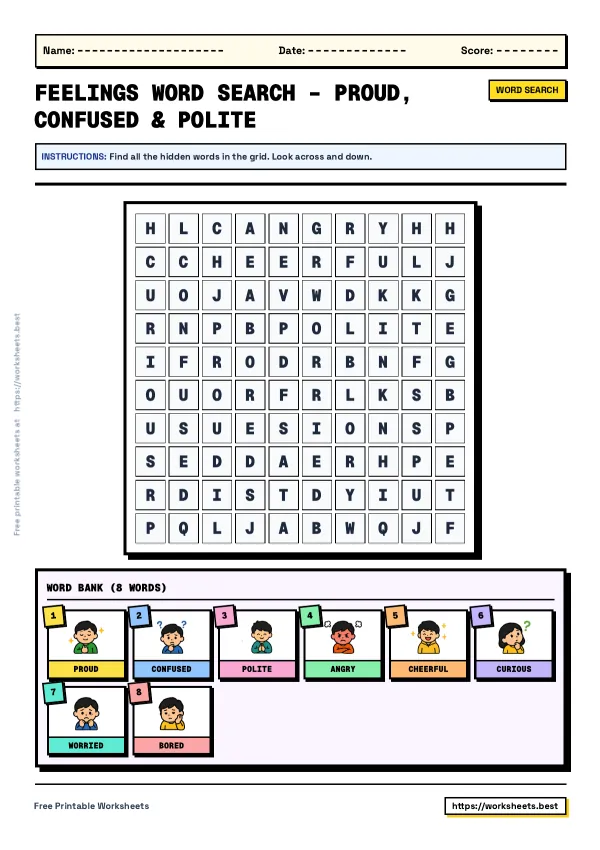
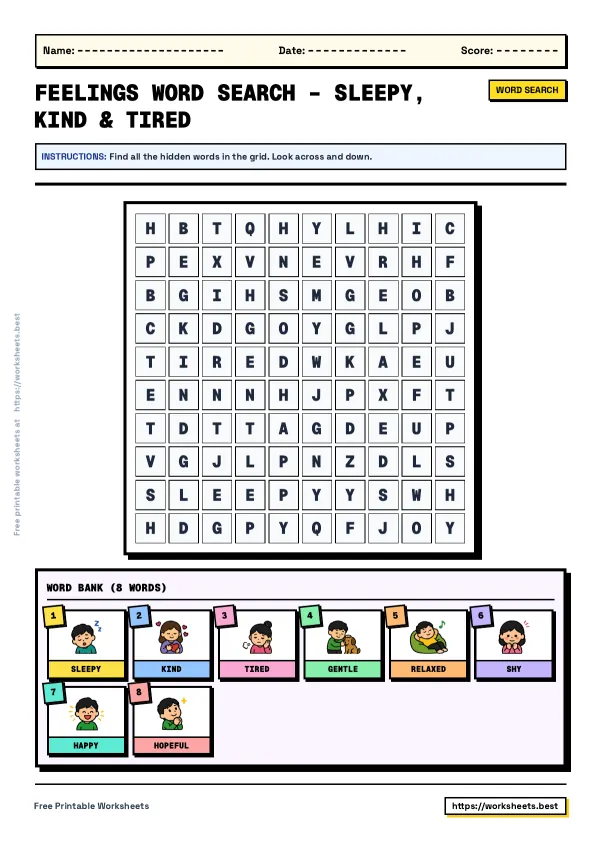
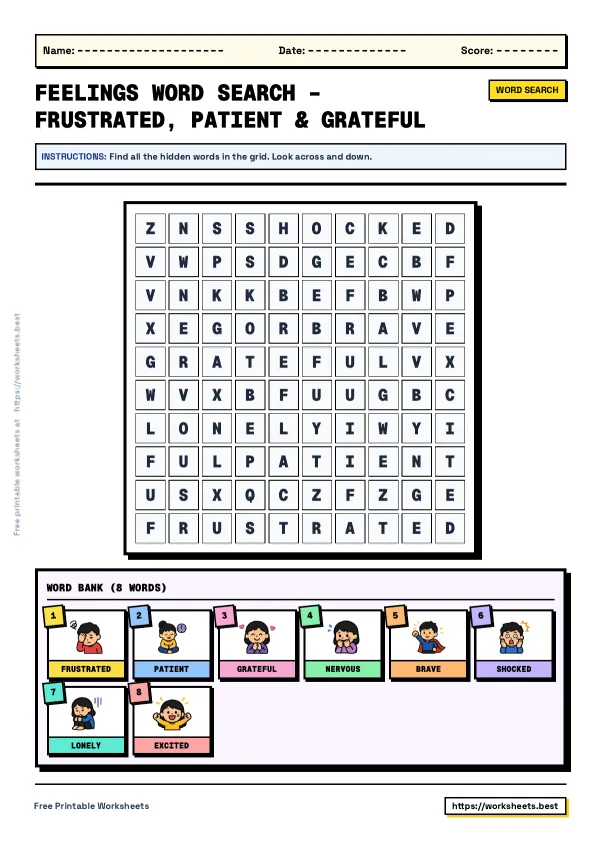
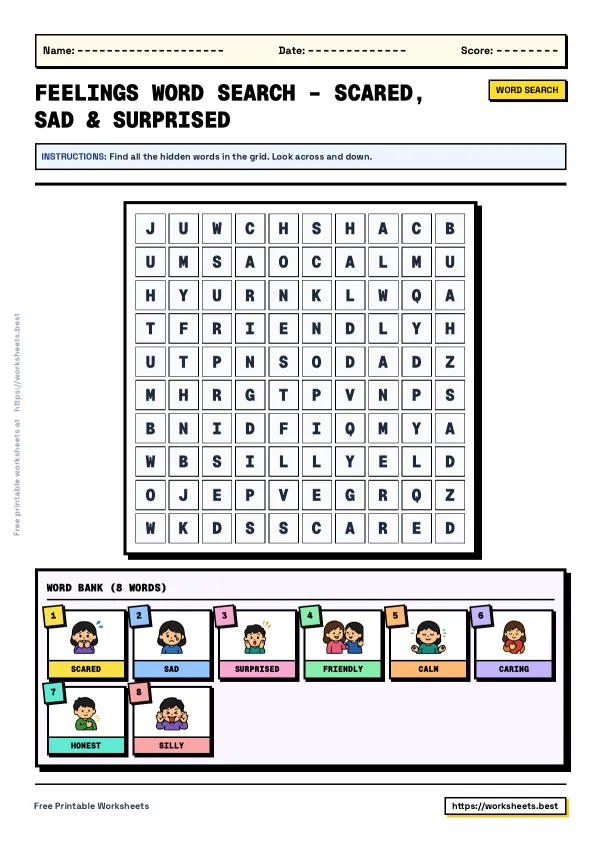
A child who can spell a feeling word is a step closer to saying it out loud, and the Emotions Worksheets give 1st, 2nd and 3rd graders that chance. Every sheet takes familiar feeling words and asks children to fit them into a crossword grid, hunt for them in a word search, or put scrambled letters back in order.
Read more +
In one crossword, children work out where brave and proud belong in the grid, and a word scramble asks them to rebuild curious and nervous from mixed-up letters. The puzzles stay at an easy level, so most of the work is reading, spelling and checking letters rather than guesswork, and children also practice problem solving and visual scanning as they work through a grid or a letter bank. The vocabulary is everyday feeling language — words children this age hear and use — which makes the spelling practice feel like a conversation about feelings.
Use a single sheet as a morning warm-up, a literacy center, or a calm task after recess when a class needs to settle. At home, a puzzle gives you a low-pressure way to talk about feelings while a child spells. Answer keys are included with every puzzle, so an adult can check quickly or leave a child to self-check.
start with these
Featured worksheets
every sheet
All Emotions worksheets
from teachers
Tips for parents and teachers
- Read the feeling words aloud together before your child starts, then ask for a quick example of a time they felt that way. Linking the spelling to a memory makes the meaning stick.
- In a word scramble, have children count the letters and write the word once in pencil before comparing it to the mixed-up letters. That checking step is where spelling habits form.
- For word searches, encourage children to trace along a row or column with a finger before circling anything. Slowing down helps them see whole word shapes instead of single letters.
- Finish by choosing two words from the puzzle and using each in a spoken sentence or a one-line journal entry. That short step turns the puzzle into vocabulary your child can actually use.
Questions parents ask
What feelings words are appropriate for 1st and 2nd graders?
Children this age usually know simple feeling words from everyday talk and picture books, and these puzzles stick to that familiar ground. Both comfortable and uncomfortable feelings appear, so children meet a full range without anything abstract.
How do crosswords and word scrambles help with spelling?
Both formats make a child hold the whole word in mind while working with its letters. Fitting a word into a grid or reordering scrambled letters means checking letter order and word length, which is exactly the skill behind accurate spelling.
Are these puzzles too easy for 3rd graders?
They are written at an easy level, which suits 3rd graders as a quick review rather than a challenge. You can raise the bar by asking for each word to be used in a sentence or sorted into comfortable and uncomfortable feelings.
What should I do when my child gets stuck on a word search?
Give the first letter and the direction to search in rather than pointing at the word itself. That keeps the visual scanning work with the child while making the task manageable.
Can these worksheets help children talk about emotions?
Naming a feeling is an early step in managing it, and a puzzle offers a low-pressure way to meet feeling words before using them about themselves. A short conversation afterward, asking which word fits today, often follows naturally.