Kindergarten Addition Worksheets
Simple practice with Kindergarten Addition Worksheets helps young children build confidence with addition and early math facts. The pages are set up as math drills, so a child reads a number sentence and writes the answer, then moves to the next one. A small set includes sheets with sums of 10 or less and an easier group that stays within 5, which gives you a clear place to start and a next step when a child is ready.
Read more +
Use the sheets in short sessions at home or during a math center in class. Read the first problem aloud together, then let the child work independently and check answers afterward. Answer keys are included, so a parent or teacher can review quickly and talk through any mistakes while the problem is still fresh.
The format suits kindergarten children who are learning to count on, recognize written number sentences, and recall simple facts. Some pages connect to standards such as K.OA.A.2 and K.OA.A.5, but the main goal is steady practice with numbers that stay manageable.
start with these
Featured worksheets
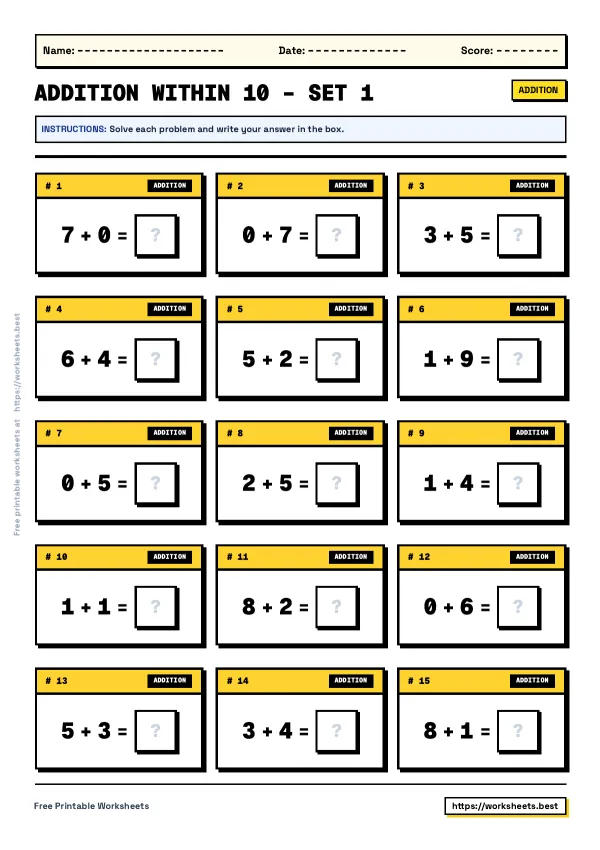
Addition Within 10 – Set 1
K–1st GradeMath Drills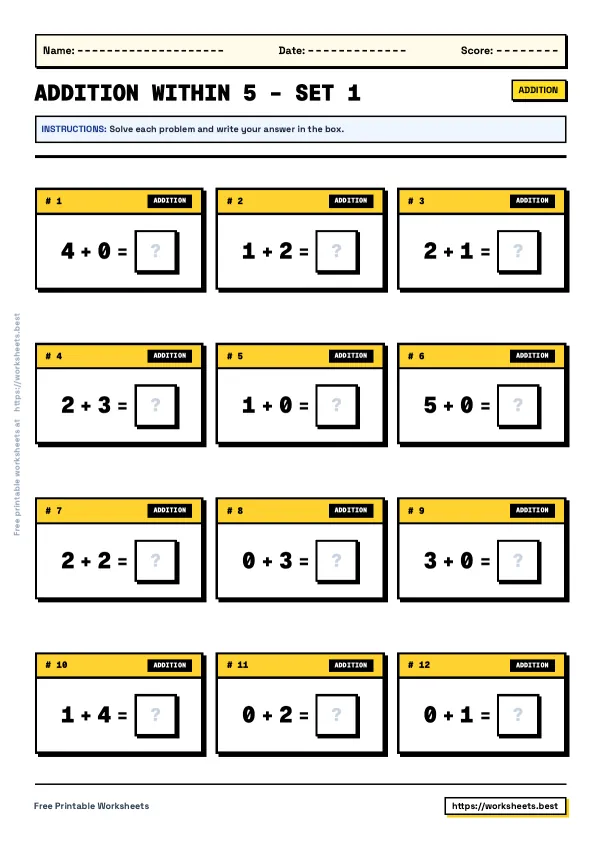
Addition Within 5 – Set 1
KindergartenMath Drills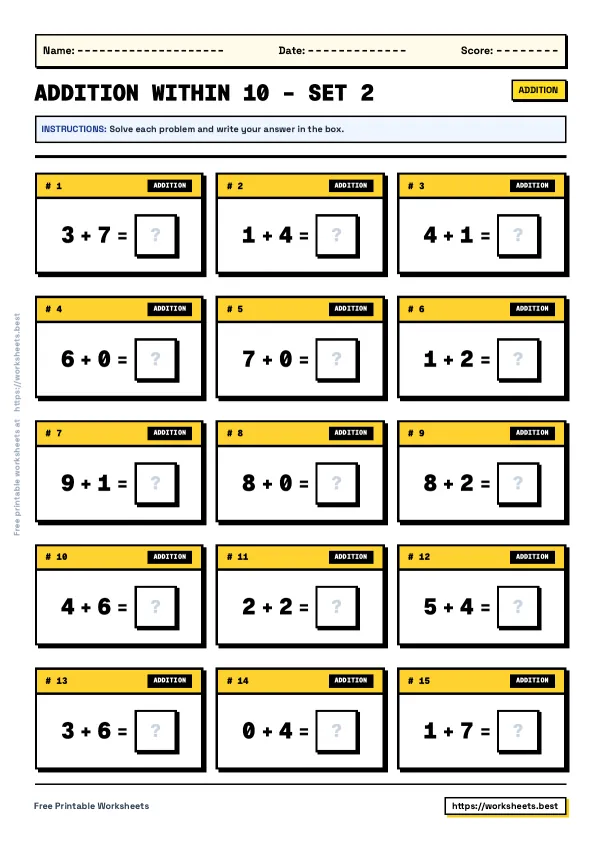
Addition Within 10 – Set 2
K–1st GradeMath Drills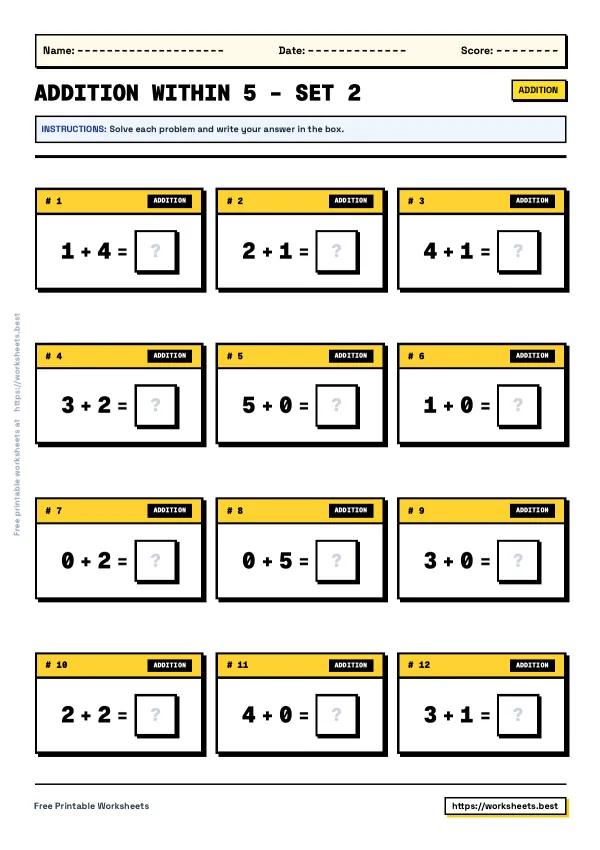
Addition Within 5 – Set 2
KindergartenMath Drills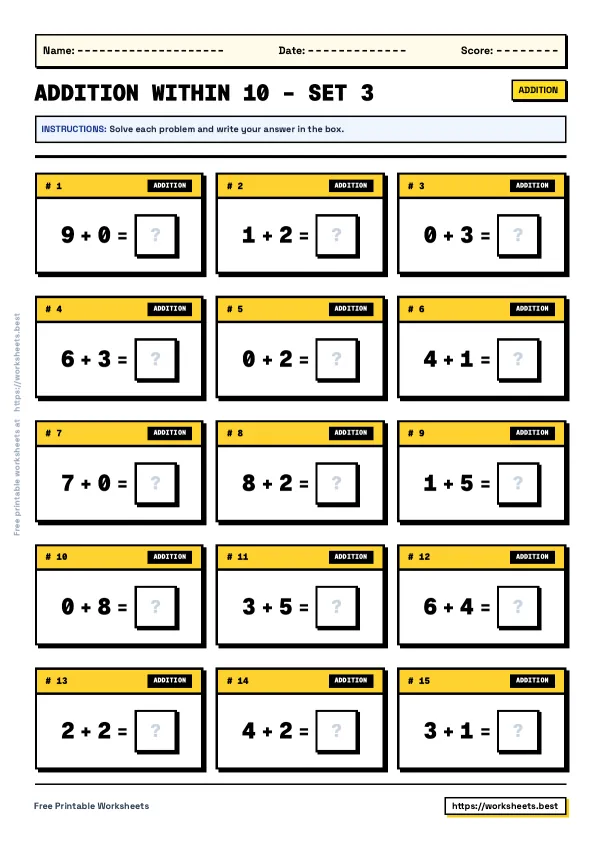
Addition Within 10 – Set 3
K–1st GradeMath Drills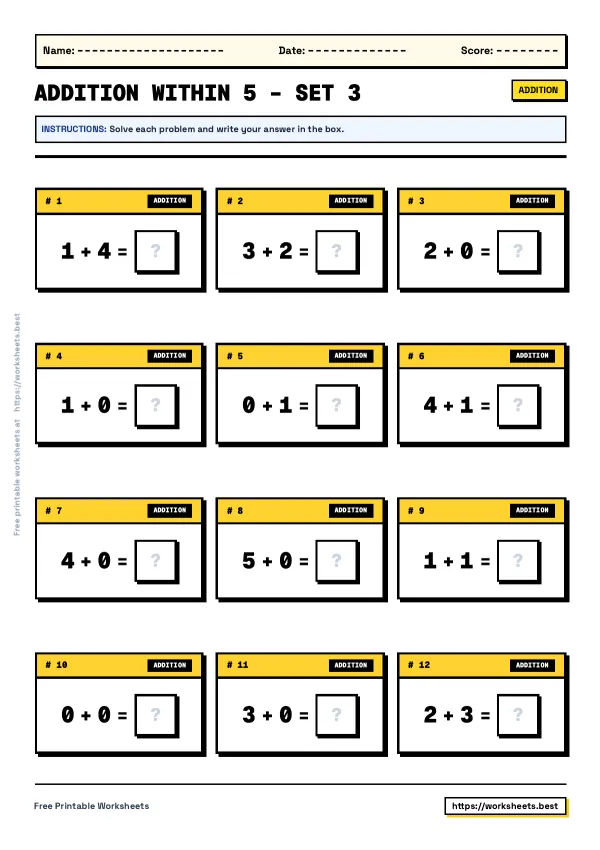
Addition Within 5 – Set 3
KindergartenMath Drills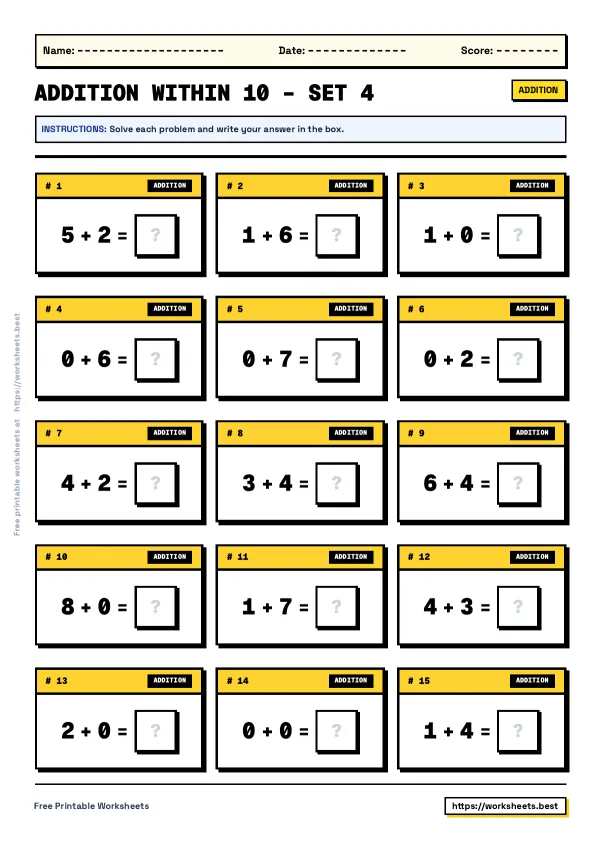
Addition Within 10 – Set 4
K–1st GradeMath Drills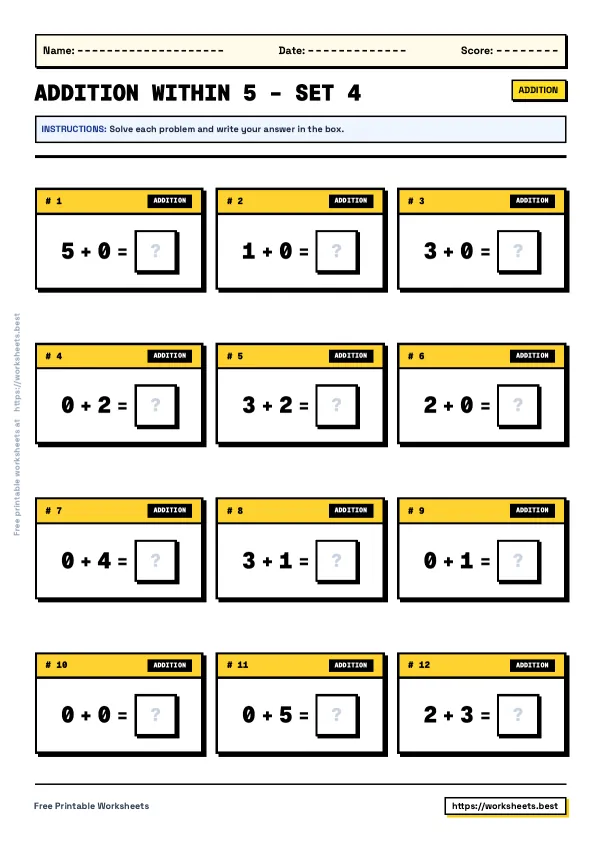
Addition Within 5 – Set 4
KindergartenMath Drills
every sheet
All Kindergarten Addition worksheets
Addition Within 5 – Set 4
KindergartenMath DrillsAddition Within 10 – Set 1
K–1st GradeMath DrillsAddition Within 10 – Set 4
K–1st GradeMath DrillsAddition Within 5 – Set 1
KindergartenMath DrillsAddition Within 5 – Set 2
KindergartenMath DrillsAddition Within 5 – Set 3
KindergartenMath DrillsAddition Within 10 – Set 3
K–1st GradeMath DrillsAddition Within 10 – Set 2
K–1st GradeMath Drills
from teachers
Tips for parents and teachers
- Start with the within-5 sheets and use counters, fingers, or a number line so the child can see the sum before writing it.
- Keep drill time short, perhaps five to ten minutes, and stop while the child is still successful rather than tired.
- Say the number sentence aloud together, such as “two plus three equals five,” then let the child write the answer on their own.
- Review missed problems right away by asking the child to show the sum with objects or by counting on from the larger number.
Questions parents ask
What addition skills should a kindergartener practice?
Kindergarten children benefit from adding within 5 and within 10, recognizing number sentences, and building recall of simple math facts. Short drill practice with counters or fingers can support both understanding and memory.
How can I help my child who is still counting on fingers?
Counting on fingers is a normal step. Let the child use fingers or counters alongside the drill, then gradually ask them to recall facts they know without counting.
Should kindergarten addition practice focus on speed or accuracy?
Accuracy comes first. Short math drills can build fluency over time, but a kindergartener should have time to think and use objects when needed.
How do I use addition drills at home without pressure?
Set aside a few minutes, read one problem together, and praise effort. Stop after a small portion of the page if attention fades, and return another day.
What does adding within 10 mean in kindergarten?
It means the total of the two numbers is 10 or less, such as 6 + 3. Children can show the sum with objects, draw it, or count on from the first number.