3rd Grade Division Worksheets
Third grade division worksheets give children a calm, focused way to practice the facts they need before longer division work begins. This small set of 3rd grade division worksheets is made up of math drills, so each page is a clean column of problems a child can work through without extra instructions to sort out first.
Read more +
The set starts with the easier facts, dividing by 2 through 5, and then moves to the tougher ones, dividing by 6 through 10. That order lets a child build speed on the smaller divisors before meeting the 7s, 8s and 9s, which are usually the slowest to stick. Because each page stays inside one fact family, you can hand out just the sheet that matches what your class is working on this week. It suits third graders, children who are 8 and 9, and it lines up with Common Core standard 3.OA.C.7, which asks third graders to know their multiplication and division facts from memory.
Use one sheet at a time at home, a few minutes a day, or as morning work, a warm-up or a math center in class. Answer keys come with every page, so checking is quick and a child can even self-check and fix a mistake right away. Children who finish early can try the same page again later in the week and compare how it went.
start with these
Featured worksheets
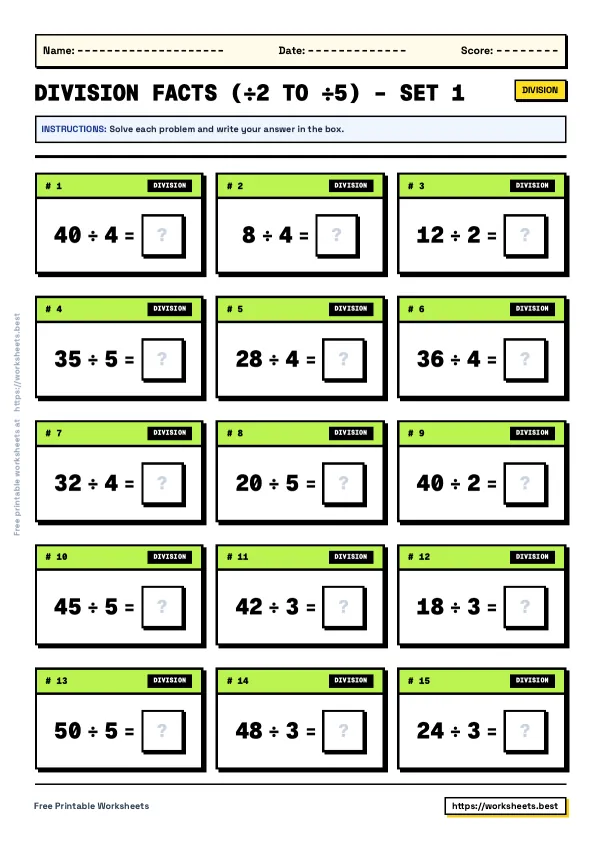
Division Facts (÷2 to ÷5) – Set 1
3rd GradeMath Drills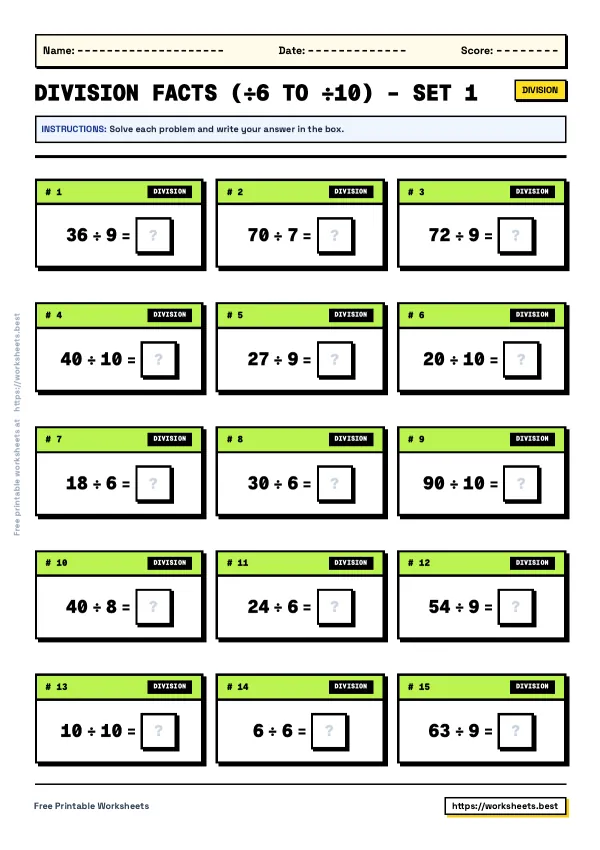
Division Facts (÷6 to ÷10) – Set 1
3rd–4th GradeMath Drills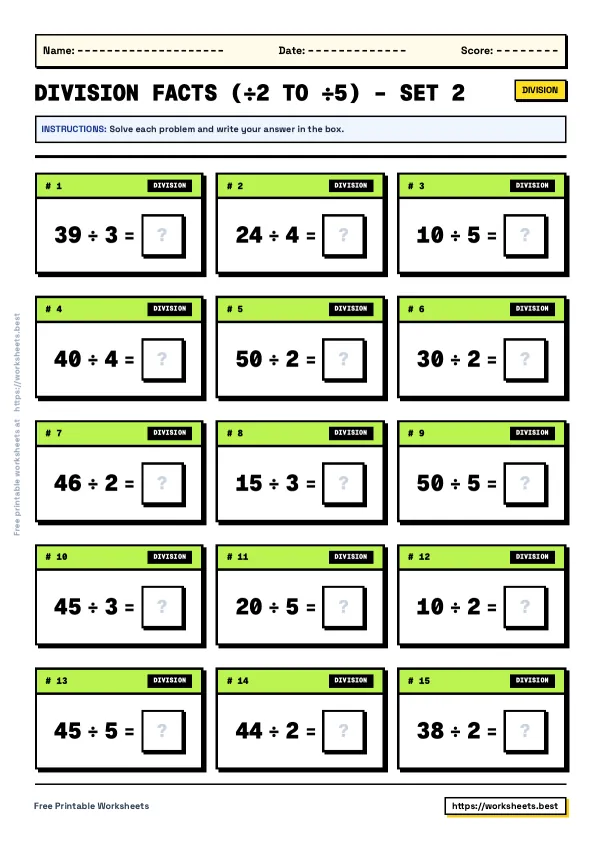
Division Facts (÷2 to ÷5) – Set 2
3rd GradeMath Drills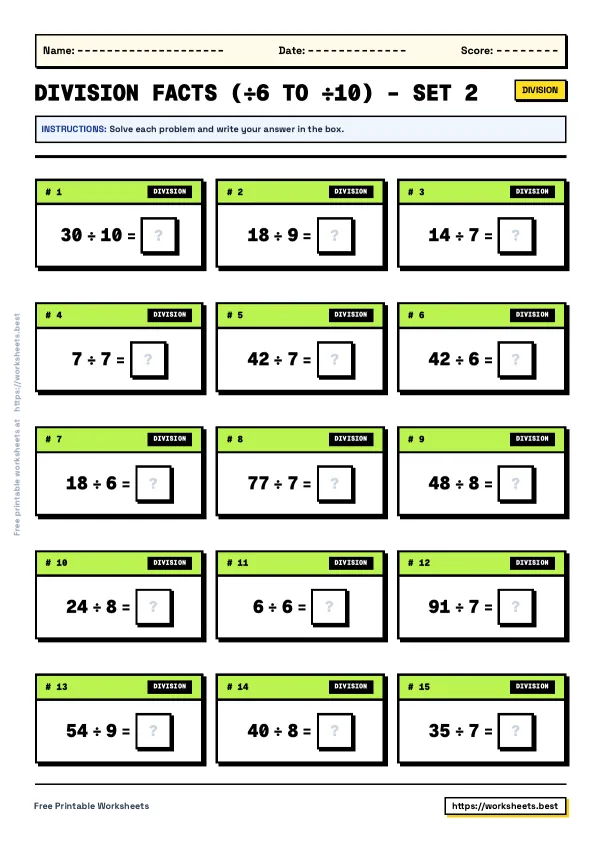
Division Facts (÷6 to ÷10) – Set 2
3rd–4th GradeMath Drills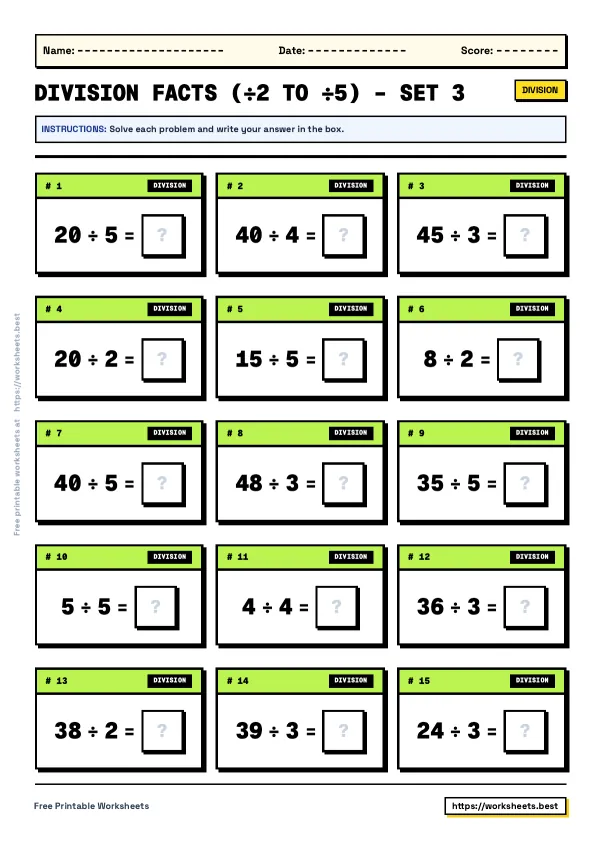
Division Facts (÷2 to ÷5) – Set 3
3rd GradeMath Drills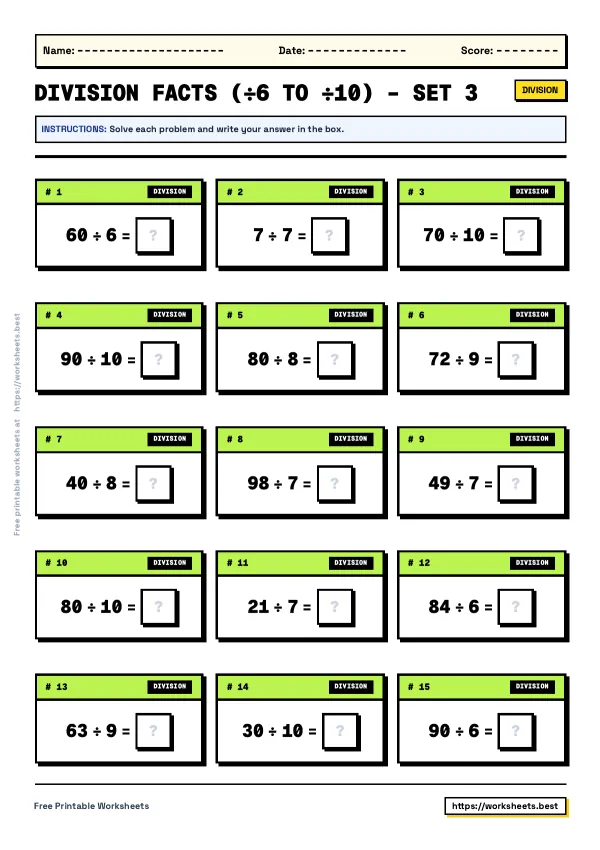
Division Facts (÷6 to ÷10) – Set 3
3rd–4th GradeMath Drills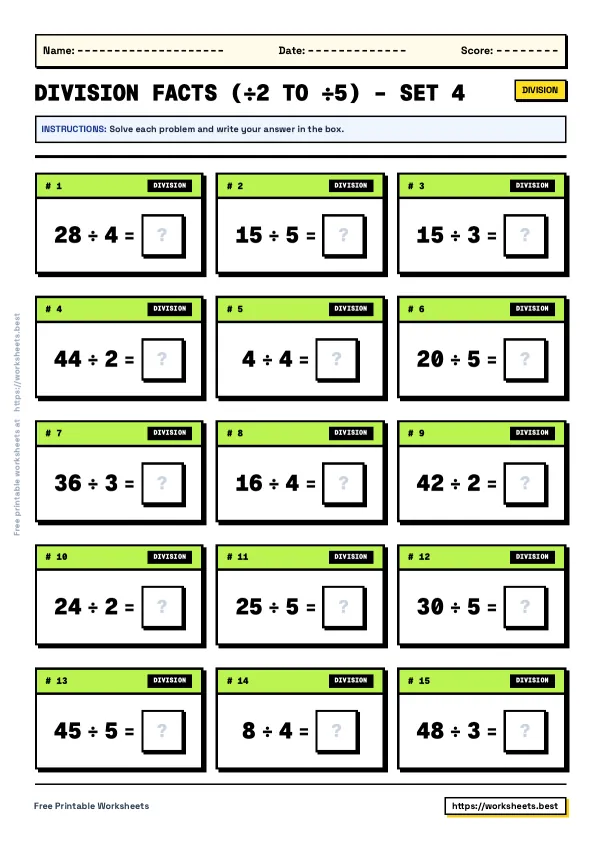
Division Facts (÷2 to ÷5) – Set 4
3rd GradeMath Drills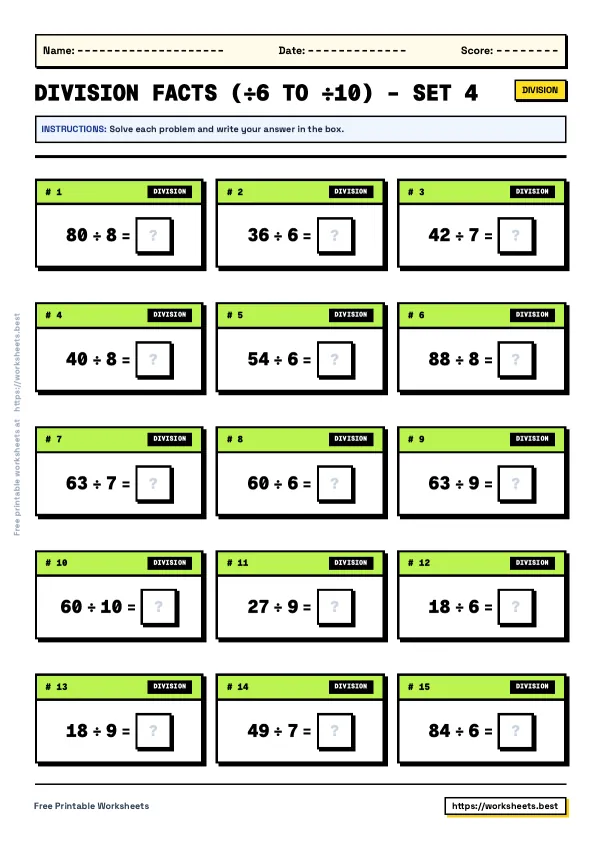
Division Facts (÷6 to ÷10) – Set 4
3rd–4th GradeMath Drills
every sheet
All 3rd Grade Division worksheets
Division Facts (÷2 to ÷5) – Set 2
3rd GradeMath DrillsDivision Facts (÷2 to ÷5) – Set 1
3rd GradeMath DrillsDivision Facts (÷2 to ÷5) – Set 3
3rd GradeMath DrillsDivision Facts (÷6 to ÷10) – Set 2
3rd–4th GradeMath DrillsDivision Facts (÷2 to ÷5) – Set 4
3rd GradeMath DrillsDivision Facts (÷6 to ÷10) – Set 1
3rd–4th GradeMath DrillsDivision Facts (÷6 to ÷10) – Set 4
3rd–4th GradeMath DrillsDivision Facts (÷6 to ÷10) – Set 3
3rd–4th GradeMath Drills
from teachers
Tips for parents and teachers
- Keep drill sessions short. Ten focused minutes beats a long sitting; stop while your child is still getting most answers right, so the practice ends on a good note.
- Follow the fact order in the set. Stay on dividing by 2 through 5 until those answers come quickly, then move to the 6 through 10 sheets, since mixed facts are harder once the easy ones are not yet automatic.
- When a child gets stuck, have them say the related multiplication fact aloud. Seeing that 42 divided by 6 is easier when they recall 6 times 7 turns a blank stare into an answer.
- Reuse the same page a few days later and compare times or mistakes. Repeating one fact family is how children move from counting on their fingers to remembering the answer.
Questions parents ask
What division facts should a 3rd grader know?
By the end of third grade, children are expected to recall multiplication and division facts through 10 from memory. Practicing in small fact families, dividing by 2 through 5 first and then 6 through 10, helps them build that recall a step at a time.
How do I help my child who is stuck on a division fact?
Connect it back to multiplication. If 24 divided by 6 is tricky, ask what times 6 makes 24 and let them use that answer. Quiet practice with the matching fact family usually helps more than a long mixed review.
How often should a third grader practice division facts?
Short sessions several times a week work better than one long sitting. Ten to fifteen minutes of drill practice a few days a week keeps the facts fresh without turning math into a chore.
My child still counts on fingers for every answer. Is that okay?
Counting is a normal first step, but third grade is when recall takes over. Practicing one fact family at a time until the answers come without counting is the way to move past fingers.
What comes after division facts in third grade?
Once the facts are quick, children use them to solve larger division problems and to see how multiplication and division undo each other. Fact fluency is what makes that next step feel manageable rather than overwhelming.