1st Grade Subtraction Worksheets
A child who can count backward is ready for the 1st Grade Subtraction Worksheets, where early subtraction practice stays clear and manageable. The pages use math drills to build math facts, and the collection is a small set that moves from facts at 10 or below to facts with numbers up to 20. Some sheets give children straightforward practice with smaller subtraction facts, while others extend the same work to larger numbers up to 20.
Read more +
The format suits 1st grade children who are learning to subtract fluently, and the within-10 drills can serve as confidence-building review. Use a sheet for morning work, a short math center, or a calm five-minute practice session at home. Children can say each fact aloud, write the answer, and check their work with the included answer keys. For class use, model one example, let children finish a few facts, then discuss any problems before they complete the rest.
The drills support Common Core skills such as 1.OA.C.6, 2.OA.B.2 and K.OA.A.2. Keep sessions short and encourage children to use counters or a number line when a fact is not yet automatic.
start with these
Featured worksheets
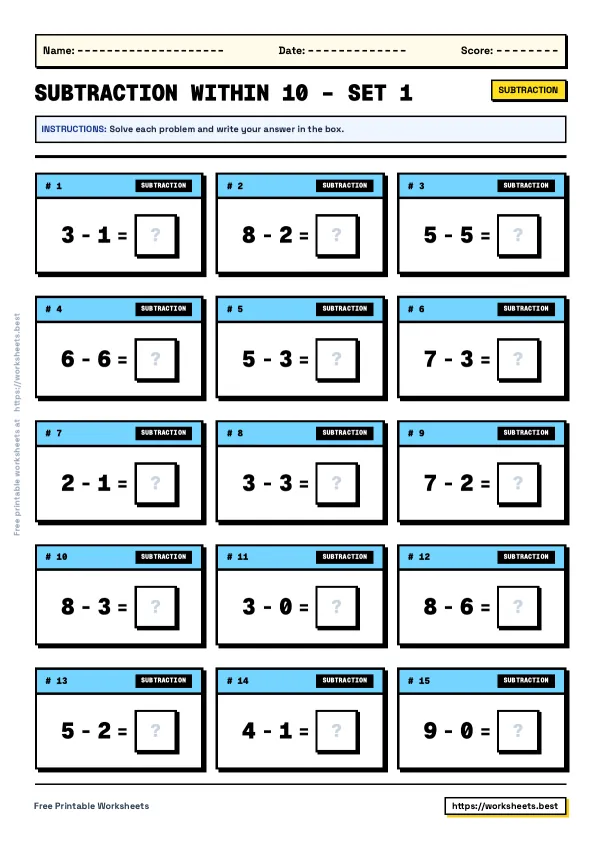
Subtraction Within 10 – Set 1
K–1st GradeMath Drills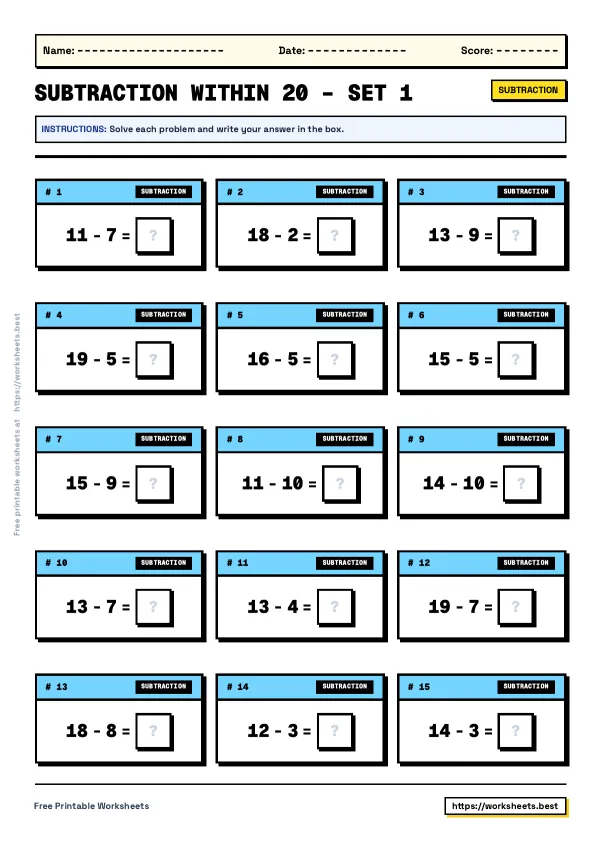
Subtraction Within 20 – Set 1
1st–2nd GradeMath Drills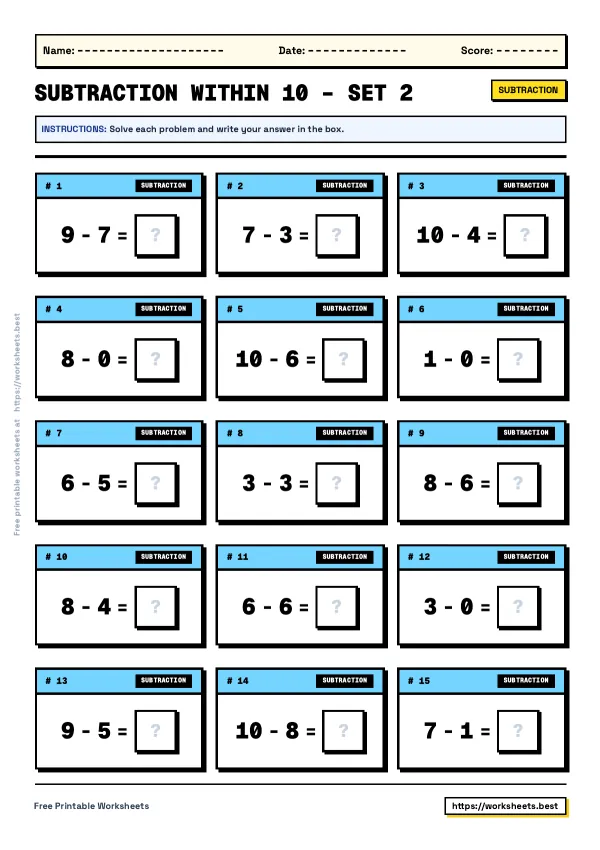
Subtraction Within 10 – Set 2
K–1st GradeMath Drills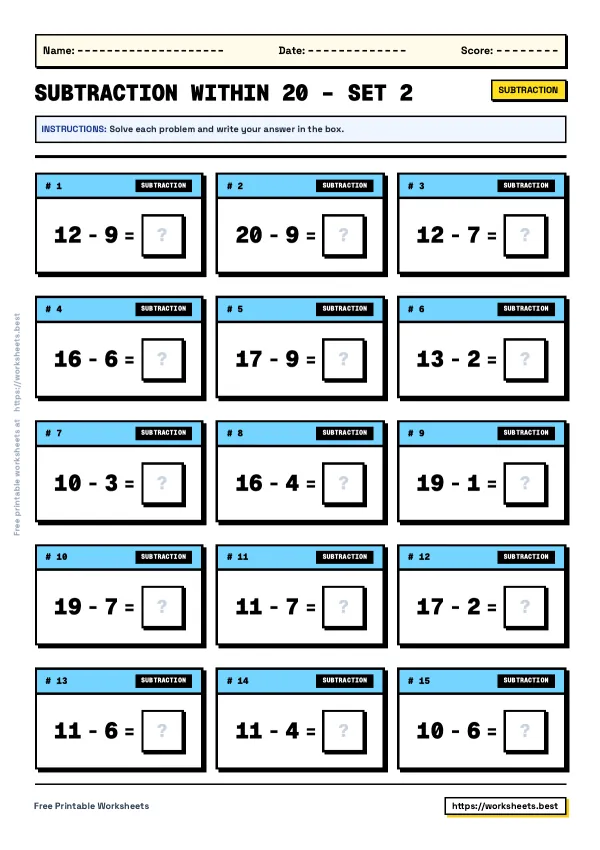
Subtraction Within 20 – Set 2
1st–2nd GradeMath Drills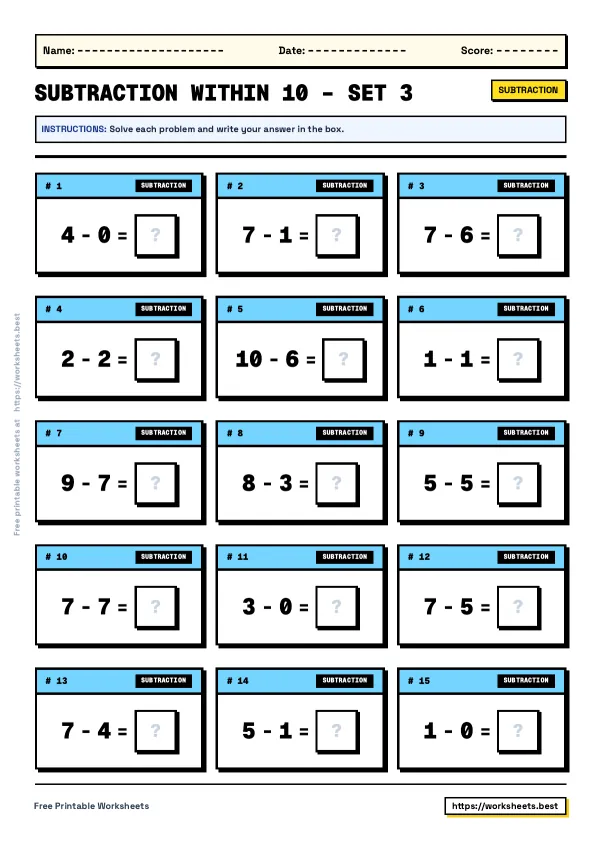
Subtraction Within 10 – Set 3
K–1st GradeMath Drills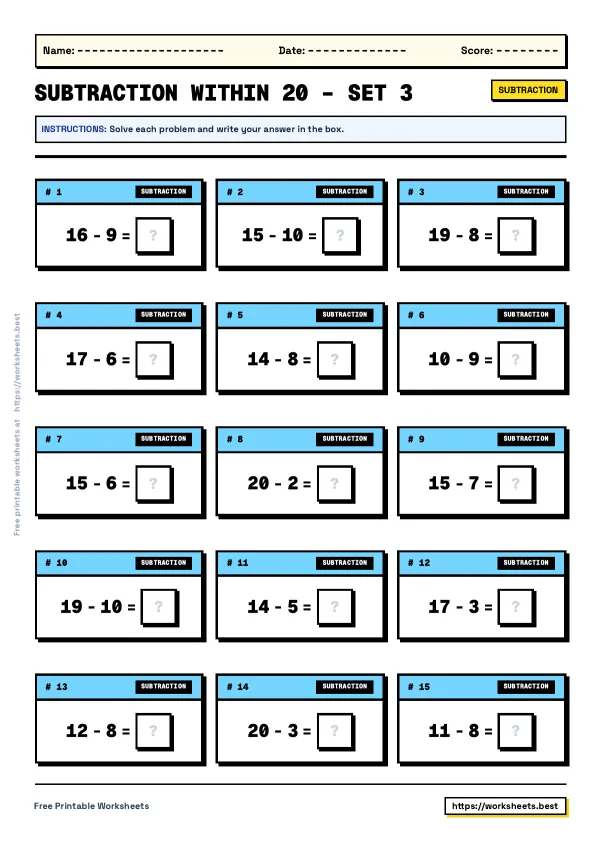
Subtraction Within 20 – Set 3
1st–2nd GradeMath Drills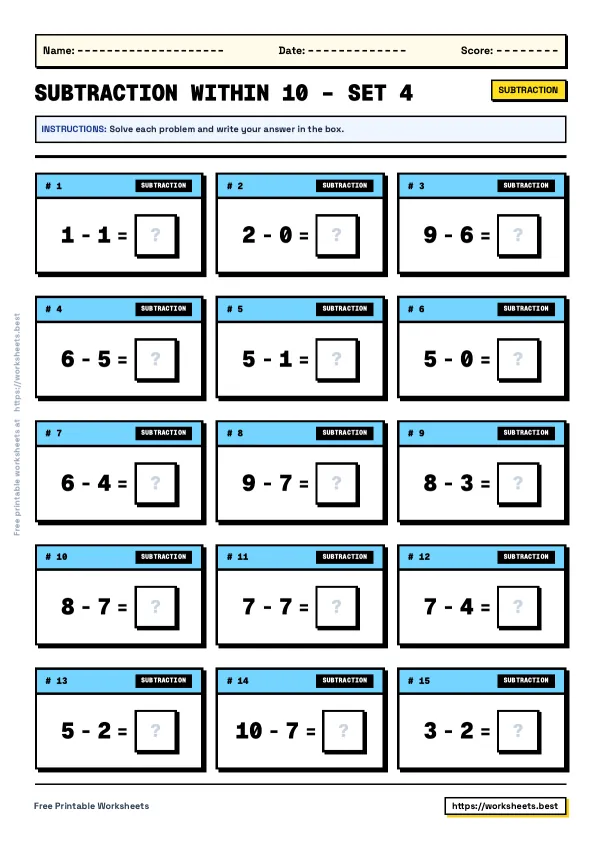
Subtraction Within 10 – Set 4
K–1st GradeMath Drills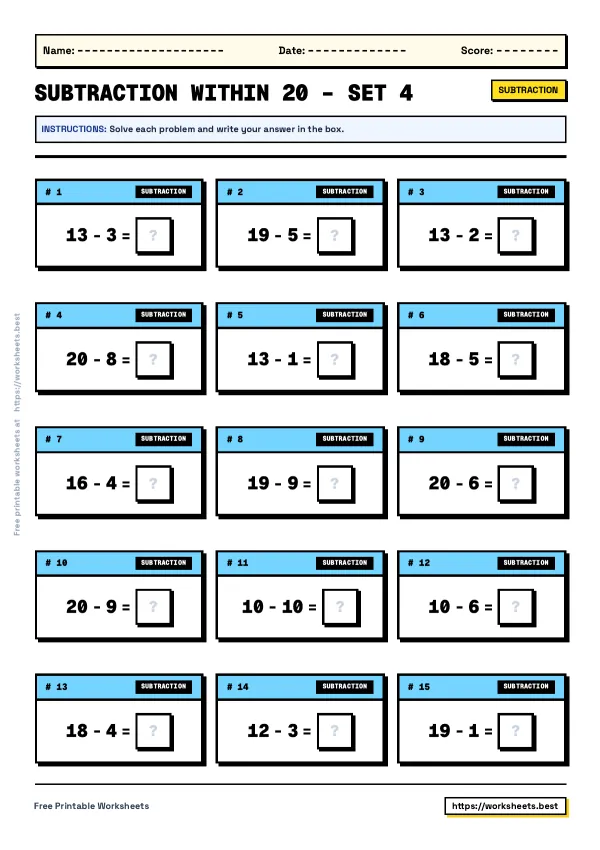
Subtraction Within 20 – Set 4
1st–2nd GradeMath Drills
every sheet
All 1st Grade Subtraction worksheets
Subtraction Within 20 – Set 1
1st–2nd GradeMath DrillsSubtraction Within 10 – Set 4
K–1st GradeMath DrillsSubtraction Within 10 – Set 1
K–1st GradeMath DrillsSubtraction Within 10 – Set 2
K–1st GradeMath DrillsSubtraction Within 20 – Set 4
1st–2nd GradeMath DrillsSubtraction Within 20 – Set 2
1st–2nd GradeMath DrillsSubtraction Within 20 – Set 3
1st–2nd GradeMath DrillsSubtraction Within 10 – Set 3
K–1st GradeMath Drills
from teachers
Tips for parents and teachers
- Begin with the smaller-number drills and let children use counters, fingers, or a number line until those facts feel secure. Move to the larger-number pages when the smaller facts are quick and steady.
- Keep each drill session short, perhaps five minutes, and stop while children are still accurate rather than tired. Short, calm practice usually supports recall better than a long sitting.
- After a sheet, ask children to explain a couple of missed facts aloud with objects or a quick drawing. That turns a correction into a short teaching moment.
- Repeat a familiar drill page a few days later and let children compare their accuracy, not just their speed. This shows progress and keeps the focus on growing confidence.
Questions parents ask
What subtraction facts should a 1st grader know by the end of the year?
Most 1st grade work centers on facts at 10 or below and then facts with numbers up to 20, with children learning to recall them accurately. The smaller-number sheets build the base, and the larger-number sheets extend the same skills.
Should my child use a number line or counters for subtraction drills?
Yes, especially at first. Counters, fingers, or a number line give children a concrete way to see subtraction, and written drills can follow once the idea is clear.
How often should a 1st grader practice subtraction at home?
Short, regular sessions work better than one long sitting. A few minutes of math facts practice several times a week, with a break when attention fades, is a steady approach for this age.
What is the difference between smaller subtraction facts and facts up to 20?
Facts at 10 or below keep both the starting number and the answer small; facts up to 20 use larger numbers. The first set helps children master smaller facts before the second set adds more to recall.
Can these subtraction drills be used in a classroom math center?
Yes. Model one fact, let children complete a short drill, and review a few answers together. Pair the sheet with counters for children who need a concrete model.