Digraph Fill-in Worksheets
Children who know their single letter sounds are ready for the next step: two letters that work together to make one sound. The Digraph Fill-in Worksheets on this page give kindergarten, 1st grade and 2nd grade children practice with those pairs, from ch, sh and th to ck, ng and ph, along with vowel teams such as ee, ea, oa, ow, ai and ay. On each sheet a picture and a partly written word are shown, and the child writes in the two letters that complete it. That single task builds phonics knowledge, spelling and reading fluency at the same time.
Read more +
The sheets move from consonant digraphs to vowel teams. One asks a child to finish words for a dolphin and a lightning bolt by choosing ck, ng or ph, while another works on ee and ea with pictures such as an eel and a beach. Every worksheet comes with an answer key, so checking a finished page takes a moment.
Use the sheets with a small group at a literacy center, as morning work, or as five quiet minutes at the kitchen table. Name the picture together first, then let the child write the missing pair and read the whole word back. Start with the consonant digraphs sh, ch, th, ck, ng and ph, then move on to the vowel teams once those are solid. Common Core RF.1.3.A names consonant digraphs as a 1st grade expectation.
start with these
Featured worksheets
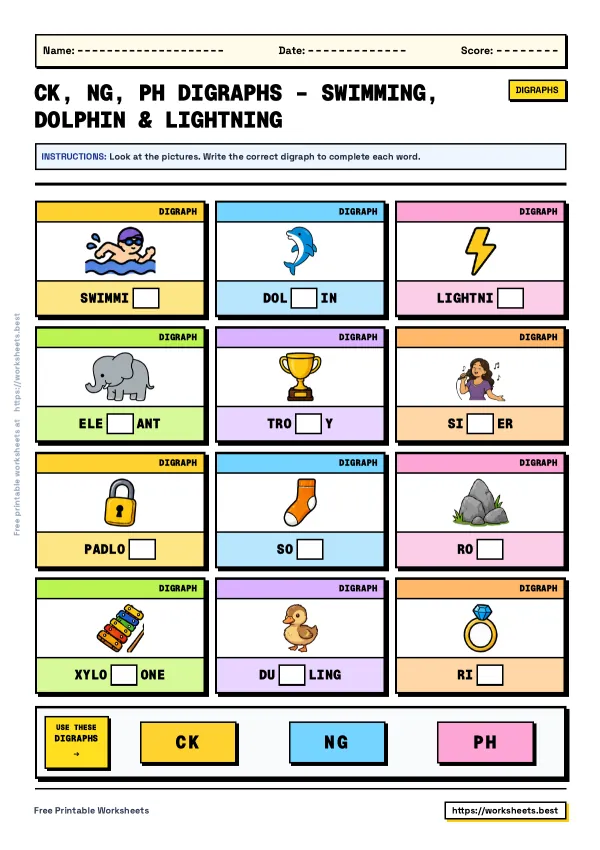
CK, NG, PH Digraphs – Swimming, Dolphin & Lightning
1st GradeDigraph Fill-in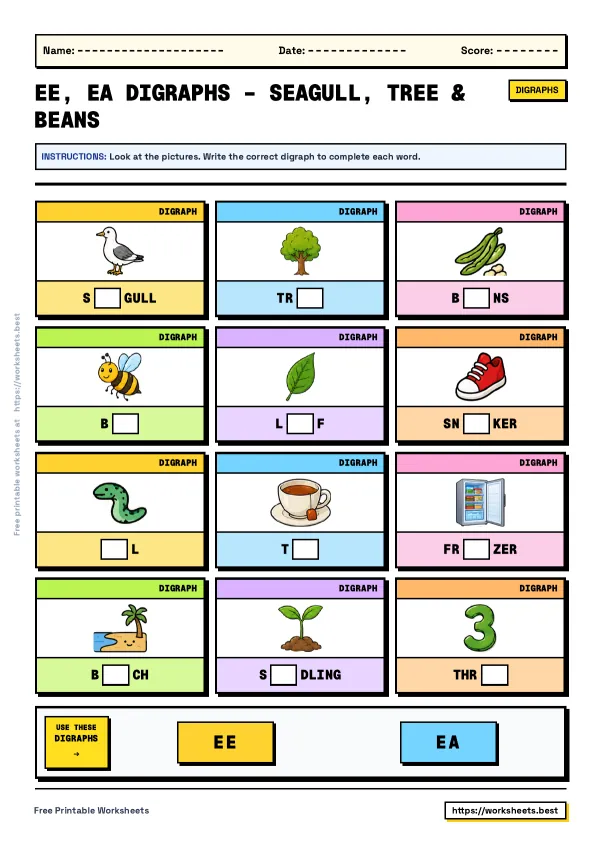
EE, EA Digraphs – Seagull, Tree & Beans
1st–2nd GradeDigraph Fill-in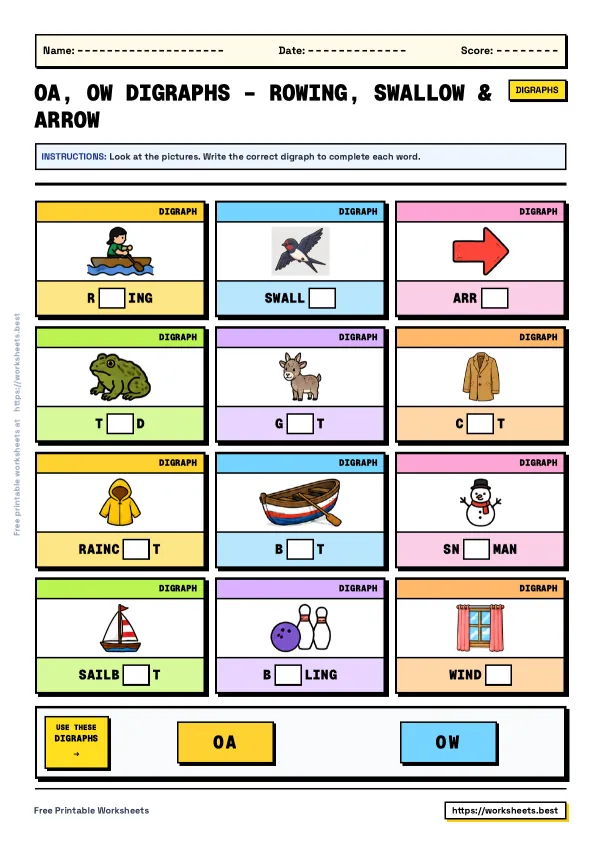
OA, OW Digraphs – Rowing, Swallow & Arrow
1st–2nd GradeDigraph Fill-in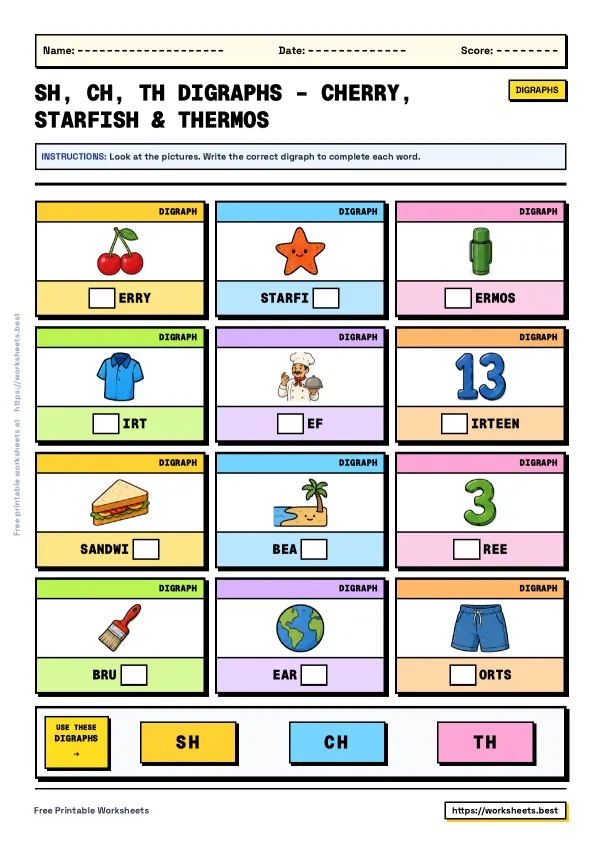
SH, CH, TH Digraphs – Cherry, Starfish & Thermos
K–1st GradeDigraph Fill-in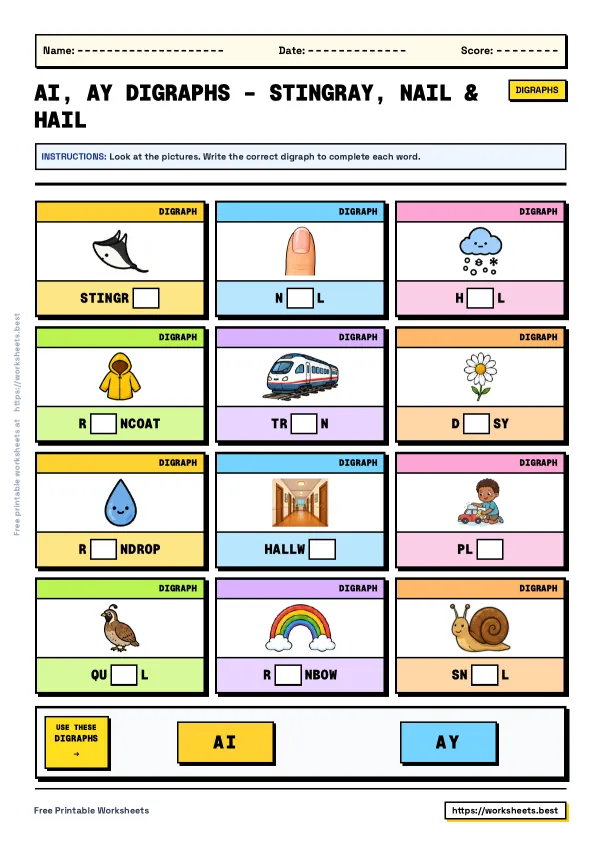
AI, AY Digraphs – Stingray, Nail & Hail
1st–2nd GradeDigraph Fill-in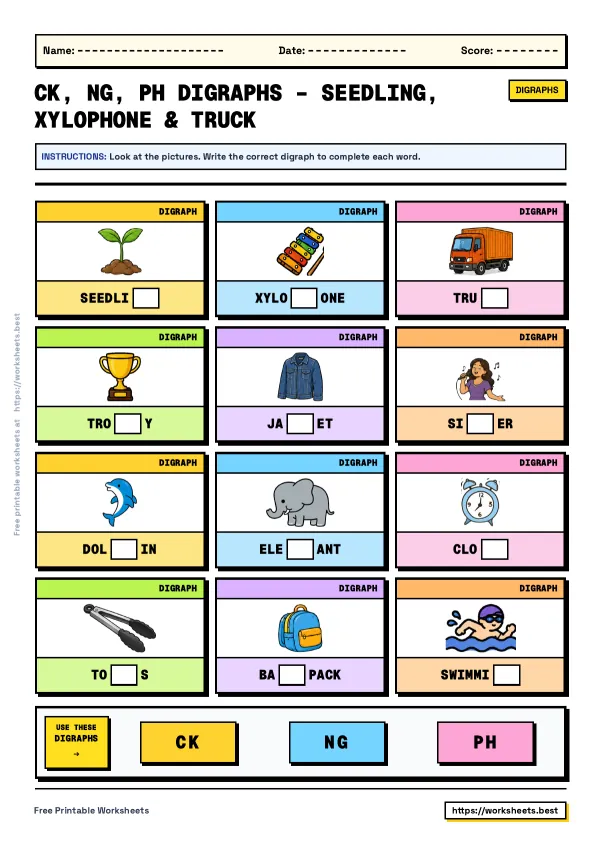
CK, NG, PH Digraphs – Seedling, Xylophone & Truck
1st GradeDigraph Fill-in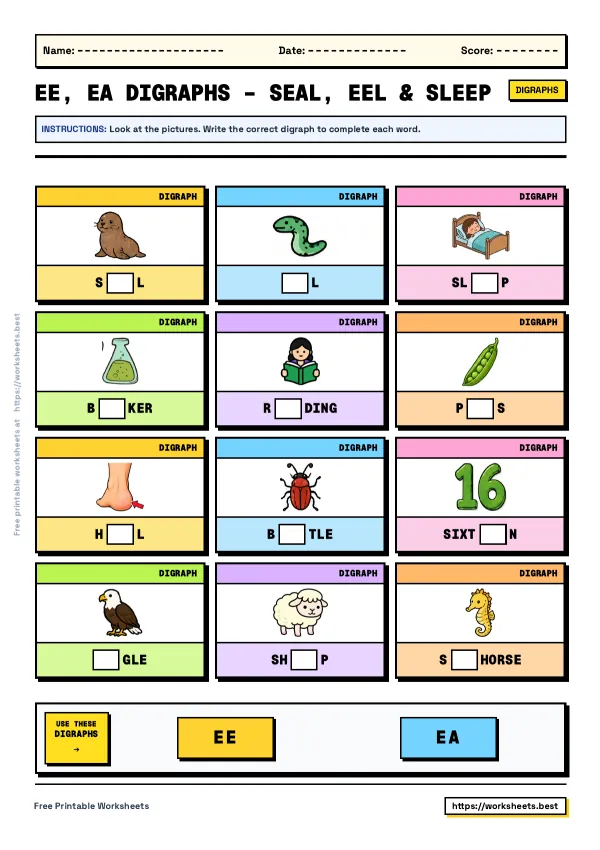
EE, EA Digraphs – Seal, Eel & Sleep
1st–2nd GradeDigraph Fill-in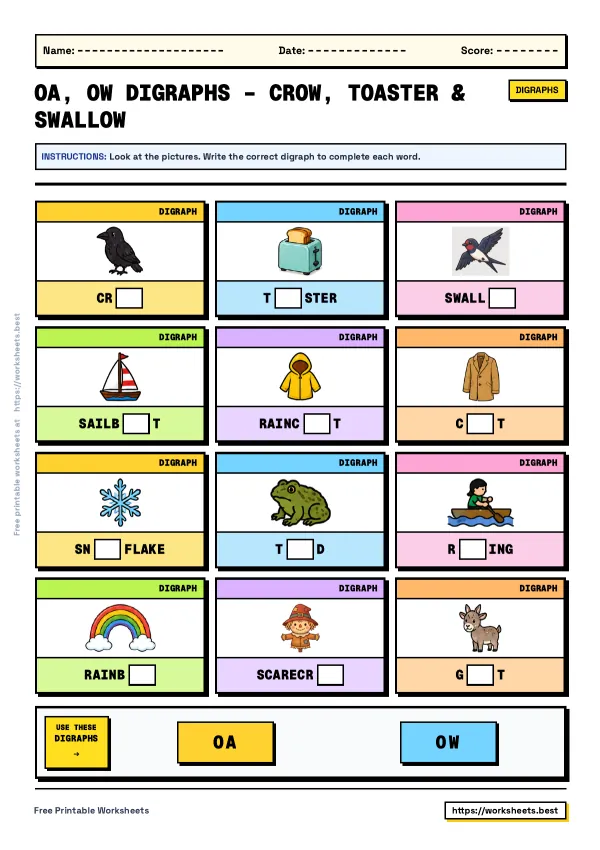
OA, OW Digraphs – Crow, Toaster & Swallow
1st–2nd GradeDigraph Fill-in
every sheet
All Digraph Fill-in worksheets
AI, AY Digraphs – Stingray, Nail & Hail
1st–2nd GradeDigraph Fill-inSH, CH, TH Digraphs – Cherry, Starfish & Thermos
K–1st GradeDigraph Fill-inCK, NG, PH Digraphs – Swimming, Dolphin & Lightning
1st GradeDigraph Fill-inEE, EA Digraphs – Seagull, Tree & Beans
1st–2nd GradeDigraph Fill-inOA, OW Digraphs – Rowing, Swallow & Arrow
1st–2nd GradeDigraph Fill-inOA, OW Digraphs – Crow, Toaster & Swallow
1st–2nd GradeDigraph Fill-inCK, NG, PH Digraphs – Seedling, Xylophone & Truck
1st GradeDigraph Fill-inEE, EA Digraphs – Seal, Eel & Sleep
1st–2nd GradeDigraph Fill-in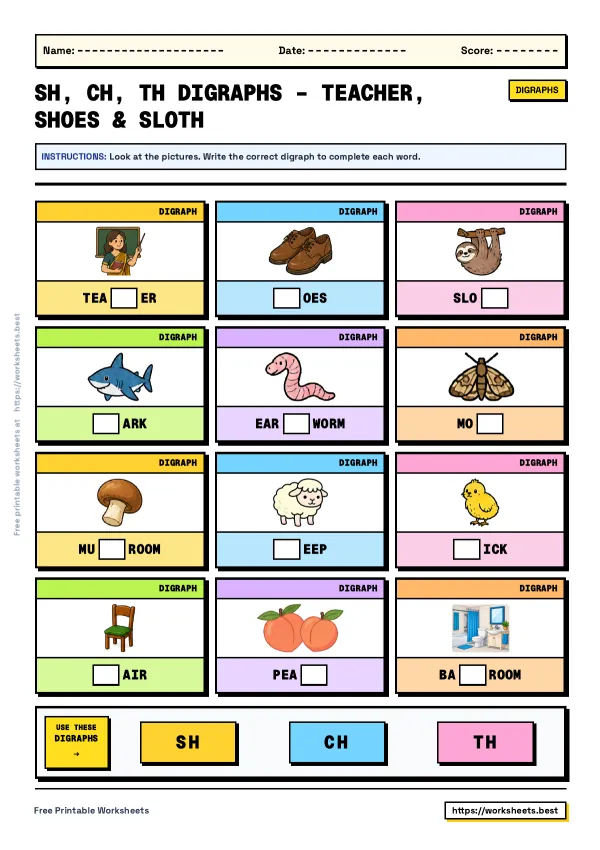
SH, CH, TH Digraphs – Teacher, Shoes & Sloth
K–1st GradeDigraph Fill-in
from teachers
Tips for parents and teachers
- Say the picture word out loud before writing anything. Hearing it first helps a child decide whether the missing sound is ch, sh, th or ng rather than guessing from the letters.
- Have the child read the completed word back and underline the two letters that spell the one sound. This links spelling to reading instead of leaving the filled-in pair on its own.
- Keep sessions short, around five to ten minutes for kindergarten and 1st grade. A few focused words stick better than a whole page written while the child is tired.
- Work through one pair at a time, such as sh and ch, before mixing several pairs on a page. Sorting by sound first gives children a rule to fall back on when they spell.
Questions parents ask
What is a digraph?
It is two letters that spell a single sound, such as ch at the end of beach or ck in the middle of a short word. Unlike a blend, the two letters are not pronounced separately.
What grade do children learn digraphs?
Kindergarten and 1st grade usually cover sh, ch, th and ck, while ng, ph and the vowel teams come in 1st and 2nd grade. Many 2nd graders still need review of the pairs they mix up.
How can I help my child tell ch and sh apart?
Ask them to say the word slowly and listen for the sound before writing anything down. Sorting a few pictures into a ch pile and a sh pile first gives them a chance to hear the difference without the pressure of spelling.
Should my child spell the whole word or just fill in the missing letters?
Filling in only the missing pair keeps the focus on the digraph, so a child is not held back by the harder parts of the word. Reading the whole word back afterward adds spelling practice without extra writing.
Are digraph worksheets still useful for 2nd graders who already read well?
Yes, especially once the sheets move into ng, ph and vowel teams such as oa and ee, which still trip up many 2nd grade readers. Spelling a pattern correctly is a separate skill from recognizing it while reading.